

A lot of people try growing blueberries once, get a handful of sad berries or none at all, and give up thinking they just don’t have “a green thumb.” Truth is, blueberries aren’t hard to grow they’re just picky about a couple of very specific things. Get those right, and the plant more or less takes care of itself for years afterward.
Here’s what actually goes into growing blueberries successfully, minus the overcomplicated advice.
Blueberries want full sun ideally 6 to 8 hours a day. This is non-negotiable if you actually want fruit. A shady corner might keep the bush alive and green, but you’ll be picking a disappointing handful of berries, if any. Give it open space too, so air can move around the plant; cramped, humid conditions invite fungal issues down the line.
If there’s one thing that decides whether your blueberry plant thrives or just limps along, it’s soil acidity. Blueberries need a pH somewhere between 4.5 and 5.5, which is far more acidic than typical garden soil. Skip this step, and you’ll likely end up with a stunted plant and yellowing leaves no matter how well you water it.
A cheap pH test kit from any garden store will tell you where you stand. If the soil’s too alkaline, mix in peat moss, elemental sulfur, or an acidic compost and don’t expect instant results. This is a slow correction, not a one-time fix.
Drainage matters too. Blueberries don’t like wet feet, but they also won’t forgive completely dried-out soil. Raised beds or slightly mounded planting rows tend to work well if your yard holds water after rain.
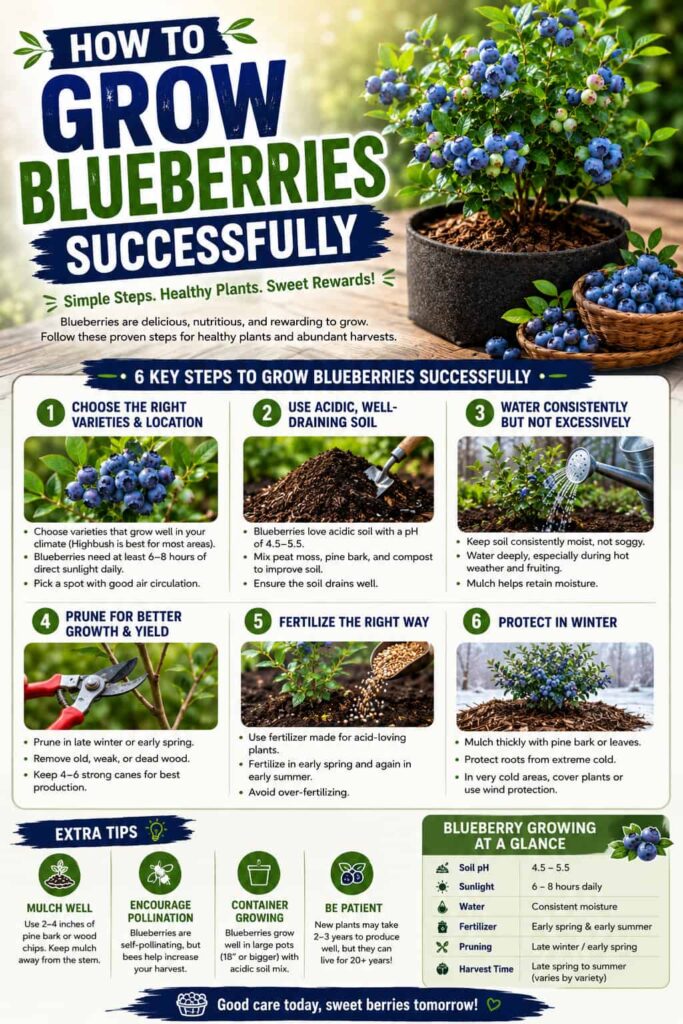
Blueberry roots sit close to the surface, which means they dry out faster than a lot of other shrubs. A rough guide is 1 to 2 inches of water per week, more during hot weather or while fruit is forming.
Mulch makes a genuine difference here pine bark, wood chips, or straw around the base help hold moisture, protect roots from temperature swings, and slowly add a bit of acidity back into the soil as they break down.
Regular fertilizer isn’t the move here. Go for one formulated for acid-loving plants the same kind sold for azaleas or camellias works well. Apply it lightly in early spring and again once harvest wraps up. More isn’t better; overdoing nitrogen just gives you a leafy plant with underwhelming fruit.
For the first couple of years, it’s fine to leave the plant mostly alone while it establishes itself. After that, prune once a year in late winter, focusing on:
The goal isn’t a tidy-looking bush it’s pushing the plant’s energy toward the branches that’ll actually give you berries next season.
| Factor | What Works Best |
|---|---|
| Sunlight | 6–8 hours of direct sun daily |
| Soil pH | 4.5 – 5.5 (acidic) |
| Watering | 1–2 inches per week |
| Fertilizer | Acid-loving plant formula, spring & post-harvest |
| Mulch | 2–3 inches, pine bark or wood chips |
| Pruning | Annually, late winter, from year 2–3 onward |
| Time to First Harvest | 2–3 years |
If you’re growing other acid-loving fruit alongside blueberries, our guide on caring for raspberry bushes covers a lot of the same soil groundwork. And if pests are the recurring headache, the natural pest control guide has a few organic options worth trying first.
For more detailed, research-based reading, the University of Minnesota Extension and NC State Extension both publish solid, home-gardener-friendly guides that go deeper into variety selection and regional planting timing.
Growing blueberries successfully really comes down to acidic soil, consistent watering, and enough sun everything else is just fine-tuning. Once a bush is established, it can keep producing fruit for over a decade with fairly minimal upkeep. The first couple of years take a bit of patience, but after that, it’s mostly just picking berries every summer.
How long does it take to grow blueberries successfully from a young plant? Most plants give a small first harvest within 2 to 3 years, reaching full production by around year 4 or 5.
Can blueberries be grown successfully in containers? Yes, as long as the pot is at least 18–20 inches wide and filled with well-draining, acidic potting mix this actually works well if your native soil isn’t ideal.
Do I need two blueberry plants to get a good harvest? Some varieties self-pollinate, but planting two different varieties nearby usually leads to a noticeably better yield.
Why isn’t my blueberry plant producing fruit even though it looks healthy? This is often a sunlight or overfertilizing issue rather than a disease check both before assuming something’s seriously wrong.
What’s the best season to plant blueberries for the best results? Early spring or fall, once the soil is workable, gives roots time to settle in before extreme heat or cold arrives.
Sign up for my newsletter to see new photos, tips, and blog posts.