

A few years back I had one decent blueberry bush and a whole lot of empty space along the back fence that I didn’t want to fill with store-bought plants every single time. Turns out you don’t have to. If you’ve got one healthy bush already, you can cut it into pieces (the plant, not literally your only bush) and grow several more from it for free. That’s really all propagation is.
If you’re wondering how to grow blueberries from cuttings without killing half of them in the process, here’s what’s actually worked, along with the mistakes that wasted a good chunk of my first attempt.
Nursery blueberry plants aren’t cheap, especially once you want three or four of them. Cuttings solve that problem, but there’s more to it than just saving money:
None of this means it’s foolproof. Some cuttings just won’t take, no matter what you do. That’s normal don’t take it personally.
This is where a lot of people go wrong, honestly. Timing matters more than technique here.
| Cutting Type | When to Take It | What the Stem Looks Like | Rooting Time | Beginner-Friendly? |
|---|---|---|---|---|
| Softwood | Late spring into early summer | Green, bends without snapping | Around 4–6 weeks | Yes, easiest to start with |
| Hardwood | Late winter, while dormant | Firm and woody | 8–12 weeks, sometimes longer | Slower but sturdier plants |
If this is your first time doing this, go with softwood. It roots faster, and honestly it’s more forgiving if you get something slightly wrong.
Pick a good parent plant. Not the struggling bush in the corner go with the one that fruited well and looks healthy. Whatever weaknesses that plant has, the cutting inherits.
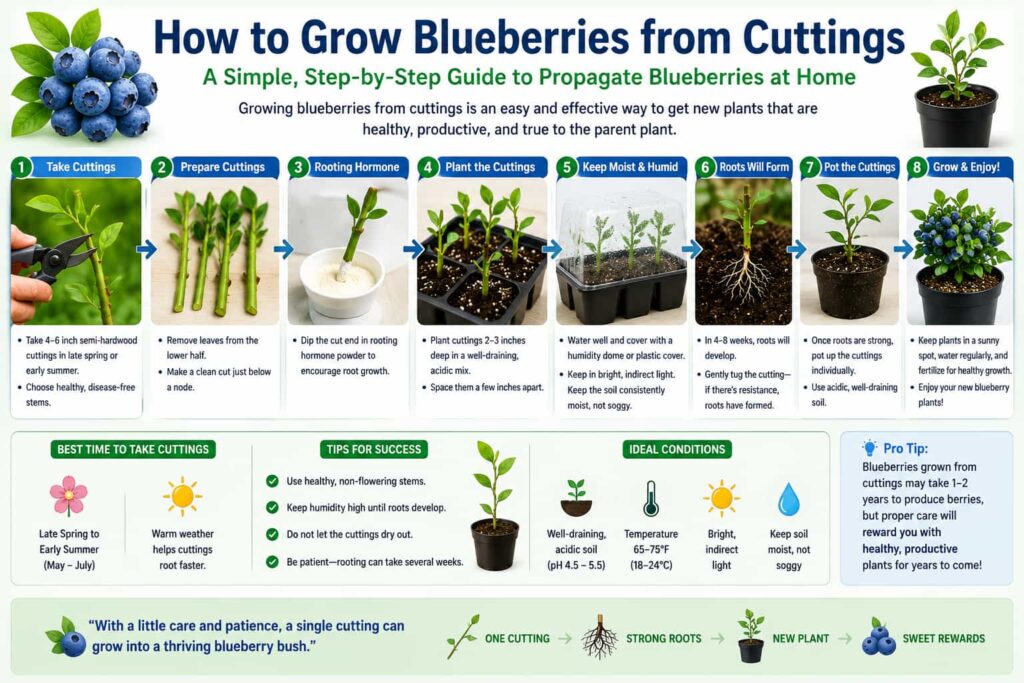
Cut a piece, roughly 4 to 6 inches. Clean shears matter here more than people think; a dull or dirty blade can bruise the stem and invite rot.
Strip most of the leaves off. Leave a couple at the top, take the rest off the lower half. The cutting doesn’t need to be feeding leaves while it’s busy trying to grow roots.
Dip the cut end in rooting hormone. You can skip this, plenty of people do, but success rates go up noticeably when you use it, especially with hardwood.
Get the soil right. Blueberries are fussy about pH, and this matters just as much for cuttings as it does for full-grown bushes. A peat moss and perlite mix, about half and half, drains well but still holds enough moisture.
Cover it. A clear plastic bag over the pot, or a humidity dome if you have one, keeps moisture in while roots form. Set it somewhere with bright, indirect light not blasting sun, that’ll fry a cutting with no roots to support it.
Check the soil every couple of days. Damp, not wet. This is probably the single most common way people lose cuttings either drowning them or letting them dry out completely.
Wait. This part is annoying but unavoidable. Depending on the type of cutting, you’re looking at anywhere from a month to three. A gentle tug that meets resistance usually means roots have formed.
Getting roots is the milestone everyone talks about, but the plant still needs a fair bit of attention after that:
If your soil isn’t naturally acidic, it’s worth reading through our guide on adjusting soil pH for berries before you transplant. And once the cutting is established, our blueberry bush care guide covers the longer-term stuff pruning, feeding schedules, that kind of thing.
From what I’ve seen (and done myself):
How long does it actually take for blueberry cuttings to root? Softwood cuttings are usually somewhere in the 4–6 week range. Hardwood takes longer, often 8–12 weeks, sometimes more depending on your climate.
Is rooting hormone necessary? Not strictly, no. But it makes a real difference in success rate, particularly with hardwood cuttings that are naturally slower to root.
What soil mix works best? A roughly 50/50 mix of peat moss and perlite. It holds moisture without staying soggy, and it keeps the acidity blueberries need.
Can this be done indoors? Yes, plenty of people start cuttings inside under a humidity dome and move them outdoors gradually once roots and some new growth appear.
What time of year is best to take the cutting? Late spring to early summer for softwood, late winter (during dormancy) for hardwood. Softwood is generally the easier starting point.
Growing blueberries from cuttings isn’t complicated once you’ve done it a couple of times, but the first attempt usually teaches you something the guides don’t quite prepare you for. Expect a few failures. Keep the ones that take, learn from the ones that don’t, and within a season or two you’ll have more bushes than you started with without spending much on any of them.
For more on propagation science, the University of Maryland Extension and Michigan State University Extension both have solid, research-based resources worth a look.
Word count: approximately 1,050 words
Sign up for my newsletter to see new photos, tips, and blog posts.