
Most people who grow blueberries just buy a young bush from a nursery and skip all this and honestly, that’s the easier route. But if you’re curious, patient, or just want to try something most gardeners never bother with, growing blueberries from seed is absolutely possible. It’s slower, it takes more attention early on, and you won’t get fruit for a few years. Still, there’s something satisfying about watching a blueberry bush grow from a seed you pulled out of an actual berry.
This guide covers what actually works, not just the quick version you’ll find copied across a dozen sites.
Worth addressing this upfront. Blueberries grown from seed don’t always turn out identical to the parent plant cross-pollination means you might get a slightly different variety than you expected. If you want a guaranteed variety with known fruit size and flavor, cuttings or nursery plants are the way to go. But if you’re not fussy about that and mostly enjoy the process, seeds are a fun, low-cost experiment. A single berry can give you dozens of seeds to work with.
If you’d rather skip straight to an established plant, our guide on how to grow blueberries in raised beds covers that route instead.
Pick a few fully ripe blueberries the darker and softer, the better, since underripe berries often have immature seeds. Mash them in a bowl with a bit of water, then let the mixture sit for a few minutes. The pulp and skin will float, while the viable seeds sink to the bottom. Skim off the floating debris and strain out the seeds that settled. Rinse them and let them air dry on a paper towel for a day.
This part isn’t optional. Blueberry seeds need a period of cold, moist conditions before they’ll germinate it mimics what they’d naturally experience overwintering outdoors. Mix the dried seeds into a small bag of damp sand or peat moss, seal it, and stick it in the fridge for about 8 to 12 weeks. Check on it occasionally to make sure the medium hasn’t dried out completely.
Skipping this step is probably the single biggest reason people fail at growing blueberries from seed the seeds just sit there and never sprout.
Once stratification is done, fill small trays or pots with a mix similar to what you’d use for an actual blueberry bed mostly peat moss or coconut coir, with some perlite mixed in for drainage. Scatter the seeds on top and press them down lightly; they need light to germinate, so don’t bury them under soil. A light dusting of fine peat is fine, but nothing more.
Keep the mix consistently moist, not soggy, and cover the tray loosely with plastic wrap to hold humidity in. Place it somewhere warm with indirect light around 65–70°F tends to work well.
Germination is slow. Don’t expect anything for the first few weeks, and don’t panic if it takes a month or more. Once seedlings appear, remove the plastic covering gradually so they adjust to normal air. Keep the soil moist and give them decent light, but avoid harsh direct sun on the tiny seedlings at this stage.
StageTypical TimeframeWhat to Watch ForSeed extraction1 daySeeds fully dried before storageCold stratification8–12 weeksMedium stays damp, not wetGermination4–8 weeks after sowingFirst true leaves appearingSeedling growth3–6 monthsSteady root and leaf developmentReady to transplant6–12 monthsSeedling is a few inches tall with sturdy roots
Once seedlings have a couple sets of true leaves and look sturdy enough to handle, move them into individual small pots with an acidic potting mix. Keep them somewhere with filtered light for a while before gradually introducing more direct sun jumping straight to full sun can shock young plants.
Blueberry seedlings grow slowly compared to most vegetables, so don’t expect fast progress. It’s normal for a seedling to stay fairly small for the first year while it builds up its root system.
Wait until seedlings are at least 6 to 12 months old and reasonably established before planting them outside, and only once the danger of frost has passed. Acclimate them gradually over a week or two by setting them outside for a few hours a day before leaving them out full time. From here, care is largely the same as any young blueberry plant acidic soil, consistent moisture, and full sun.
If you’re planning to grow them on afterward, our piece on building healthy garden soil is a good next step before transplanting outdoors permanently.
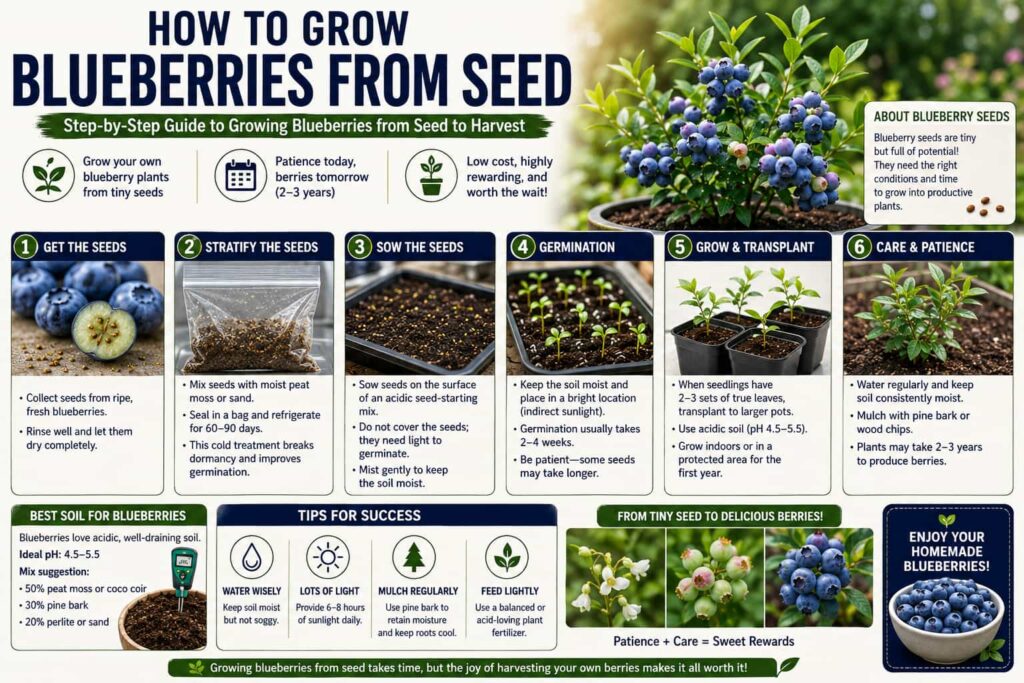
This is usually the question people ask first, and the honest answer is: a while. Blueberry plants grown from seed typically take 3 to 5 years to produce their first real harvest, sometimes longer. It’s a genuine test of patience, which is part of why most people skip this method entirely and buy an established plant instead.
1. Can any blueberry variety be grown from seed? Technically yes, but the resulting plant may not match the parent exactly due to cross-pollination. Named varieties from nurseries are usually propagated by cuttings for this reason.
2. Do blueberry seeds really need cold stratification? Yes without a cold, moist period first, germination rates drop dramatically. It’s not a step worth skipping.
3. How long does it take blueberry seeds to germinate? After stratification, expect anywhere from 4 to 8 weeks, sometimes longer. It’s a slow process compared to most seeds.
4. Can I start blueberry seeds indoors year-round? Yes, as long as you handle the cold stratification separately in the fridge first. After that, indoor conditions with good light work fine at any time of year.
5. Is it worth growing blueberries from seed instead of buying a plant? If you’re after fruit quickly, no buying an established plant is far more practical. If you enjoy the process itself, it’s a worthwhile experiment with very little cost involved.
Growing blueberries from seed isn’t the practical choice if you’re after fruit fast, but it’s a genuinely interesting project if you’ve got the patience for it. The key steps that actually matter are cold stratification and not rushing the seedling stage skip either one and you’ll likely be disappointed. From there, it’s mostly a waiting game before you end up with a plant ready for the garden.
External References:
Sign up for my newsletter to see new photos, tips, and blog posts.