
A lot of people assume you need a big backyard to grow fruit at home, but that’s just not true for blueberries. They actually do surprisingly well in containers, and honestly, growing them in a pot can be easier than planting them in regular garden soil because blueberries are picky about one thing: acidity. And that’s much easier to control in a pot than in the ground.
If you’ve been searching “how to grow blueberries in a pot,” here’s everything you actually need to know, without the fluff.
Blueberries need soil that’s on the acidic side, somewhere around pH 4.5 to 5.5. Most garden soil isn’t naturally that acidic, so gardeners often struggle to get the right balance in the ground. In a pot, you’re basically starting from scratch you fill it with the mix the plant actually wants, instead of fighting whatever soil you already have.
There are a few other perks too:
Not all blueberry bushes are pot-friendly some varieties grow into tall shrubs that need real garden space. For containers, stick with compact or dwarf types.
| Variety | Approx. Height | Good For | Pollination |
|---|---|---|---|
| Top Hat | 1–2 ft | Small pots, balconies | Self-pollinating |
| Northsky | 1.5–2 ft | Cold climates | Self-pollinating |
| Sunshine Blue | 2–3 ft | Warmer regions | Self-pollinating |
| Patriot | 3–4 ft | Larger pots | Self-pollinating |
| Duke | 4–5 ft | Bigger patios | Partially self-pollinating |
If this is your first time growing blueberries, Top Hat or Northsky are the safest bets they stay small and don’t demand much.
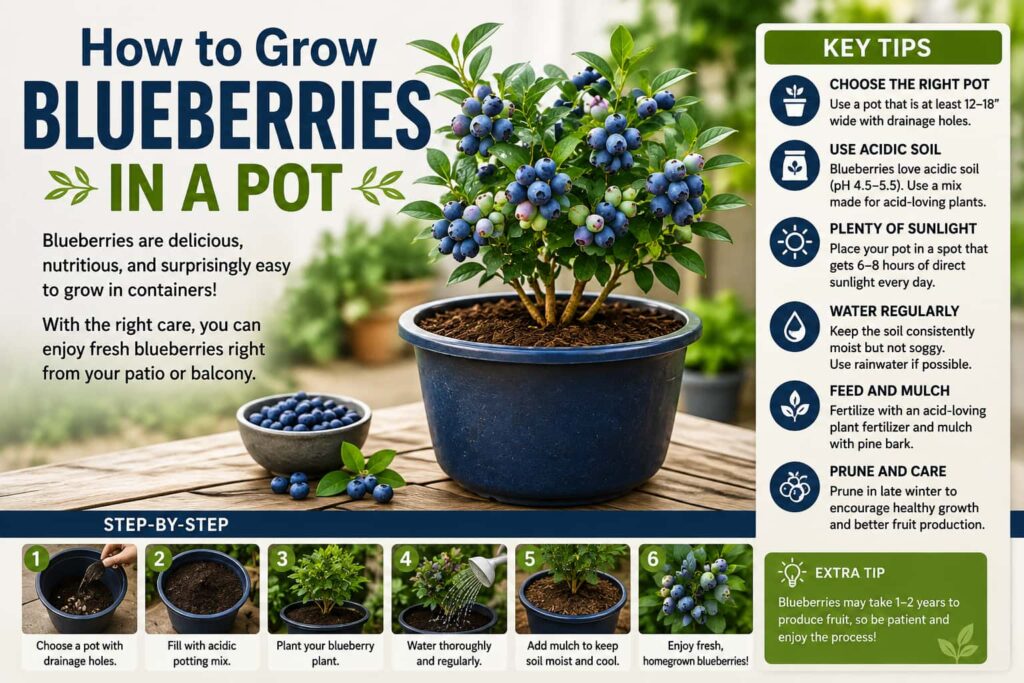
Choose the container first. Bigger is generally better since blueberry roots don’t like being cramped. Plastic or glazed ceramic pots hold moisture longer than terracotta, which tends to dry out fast in hot weather.
Get the soil right. This is the step people skip and regret later. Regular potting soil or garden soil is too alkaline for blueberries it’ll stunt growth even if everything else is perfect. Go for a mix made for acid-loving plants, or make your own with peat moss and pine bark fines.
Plant it gently. Dig a hole a bit bigger than the root ball, set the plant in, and backfill loosely. Don’t pack the soil down hard roots need some breathing room.
Water it well right after planting. Water until it runs out the bottom of the pot. From here on, the soil should stay consistently moist, not soaked, not bone dry.
Mulch on top. A couple inches of mulch keeps moisture in and the roots cool, and it slowly feeds the soil as it breaks down.
Find the sunniest spot you have. Blueberries can survive partial shade but won’t fruit well without decent sun at least 6 hours a day is the target.
Watering is the thing you’ll deal with most. Pots dry out way faster than ground soil, especially in summer, so check the top inch of soil regularly if it’s dry, water it.
Fertilizing every 4 to 6 weeks during the growing season with something made for acid-loving plants (azalea or camellia fertilizer works fine) keeps the plant fed without messing with the pH balance.
Pruning isn’t needed in year one, but once the bush is 2–3 years old, trim off dead or weak branches in late winter. It pushes the plant to put energy into new, fruit-bearing growth instead.
Repotting every couple of years is worth doing as the roots fill up the container. If you’re already dealing with containers for other fruit, our earlier post on choosing the right pots for fruit trees covers sizing in more detail.
Winter protection matters if you’re somewhere cold either move the pot somewhere sheltered or wrap it in burlap so the roots don’t freeze solid.
| Problem | Usual Cause | What to Do |
|---|---|---|
| Leaves turning yellow | Soil pH too high | Add sulfur or switch to acidic fertilizer |
| Plant isn’t fruiting | Low sunlight or no cross-pollination | Move to full sun, add a second variety |
| Roots rotting | Overwatering, bad drainage | Cut back watering, improve drainage |
| Growth is slow | Pot too small, poor soil mix | Move to a bigger pot with fresh mix |
Bugs happen too, especially once fruit shows up. If pests are an ongoing issue, we’ve got a separate guide on natural pest control for potted plants that covers this without chemicals.
For anyone who wants the deeper science on soil pH and blueberry nutrition, Oregon State University’s Extension Service has solid, research-based info that applies to container growing too.
How long until a potted blueberry plant actually gives fruit? Usually around 2–3 years, though you might get a handful of berries in year one depending on how mature the plant was when you bought it.
Can blueberries be grown indoors in a pot? Not really, not long-term. They need real sunlight and outdoor pollination to thrive. You can start seedlings indoors, but move them outside once it’s warm enough.
What size pot do blueberries actually need? Start with at least 18–24 inches wide and deep, and plan to size up as the plant grows.
Do I need two blueberry plants for pollination? Most varieties sold for pots are self-pollinating, but having two different varieties nearby usually means bigger berries and a better harvest overall.
What’s the best soil for blueberries in containers? Something acidic, pH 4.5–5.5, ideally a peat moss and pine bark mix. Regular potting soil is almost always too alkaline on its own.
Blueberries in pots aren’t complicated once you get the soil acidity sorted out that’s really the one thing that trips people up. Get a decent-sized container, the right soil mix, enough sun, and consistent watering, and the plant pretty much takes care of the rest. Give it a couple of years and you’ll have your own steady little blueberry harvest without ever needing a backyard.
Sign up for my newsletter to see new photos, tips, and blog posts.